
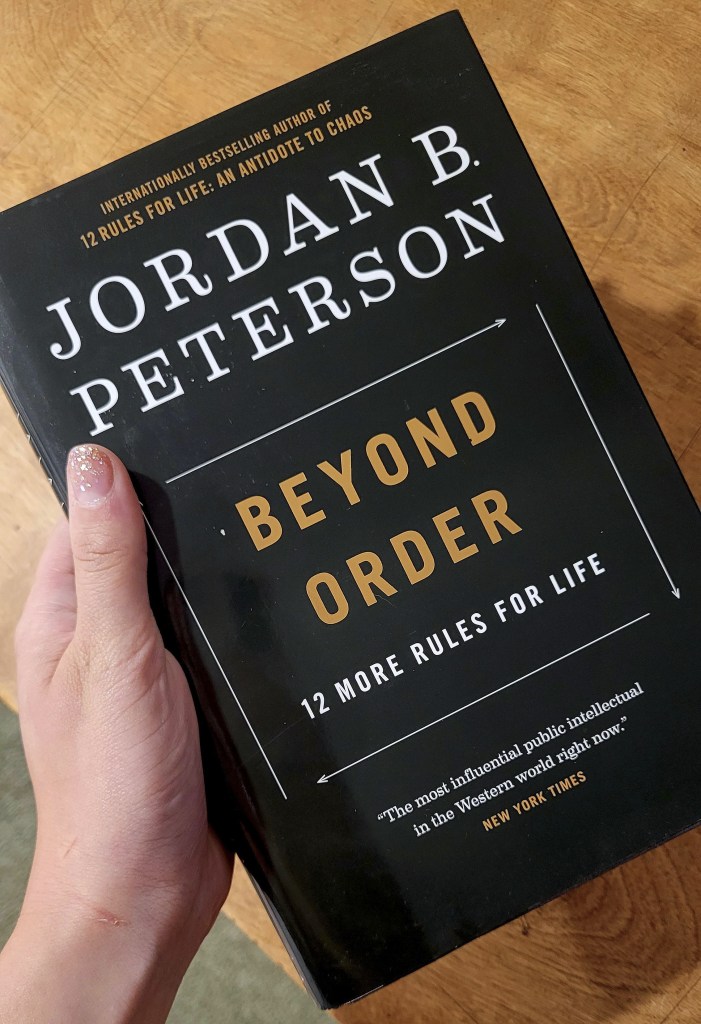
In this book, Jordan Peterson offers principles to help navigate life’s complexities. He combines practical advice, philosophical insights, and personal anecdotes to provide a guide for achieving a more meaningful and stable life. Whether you’re a fan of his earlier work or new to his ideas, “Beyond Order” offers thoughtful reflections on personal development and the human experience.
I am really impressed by Peterson’s ability to not only make me reflect, but make me want to reflect. This book definitely made me think and question different parts of my thought-process and personality, but it also made me take a broader look at the society around me.
As the title clearly states, this book is organized into 12 “rules”. I thought it would be interesting to share a few quotes from each of the 12 rules that struck me as perplexing, convincing, meaningful, or motivational:
Rule I: Do not carelessly denigrate social institutions or creative achievement
There are unlimited problems and there are hypothetically unlimited potential solutions, but there are comparatively limited number of solutions that work practically, psychologically, and socially simultaneously. (p.10)
It’s not whether you win or lose. It’s how you play the game. (p.17)
Today’s beginner is tomorrow’s master. (p.19)
It truly seems that it is better to give than to receive. (p.23)
We modify our selfish proclivities, learning not to always put ourselves first. Less obviously, but just as importantly, we may also learn to overcome our naive and too empathetic proclivities (our tendency to sacrifice ourselves unsuitable and unusual to predatory others) when our peers advise and encourage us to stand up for ourselves. (p.25)
Someone who is sophisticated as a winner wins in a manner that improves the game itself, for all the players…to adopt authority is to learn that power requires concern and competence. (p.27)
Highly social creatures such as we are must abide by the rules, to remain sane and minimize unnecessary uncertainty, suffering, and strife. However, we must also transform those rules carefully, as circumstances change around us…The refusal to conform when the social surround has become pathological, incomplete, archaic, wilfully blind, or corrupt is something of even higher value as is the capacity to offer creative, valid arguments. (p.29)
Learn to communicate in a productive manner about topics that could easily have generated counterproductive sensitive overreacting. (p.39)
Respect for the rules, except when following those rules means disregarding or ignoring or remaining blind to an even higher moral principle. (p.44)
Every rule was once a creative act, breaking other rules. Every creative act, genuine in its creativity, is likely to transform itself, with time, into a useful rule. It is the living interaction between social institutions and creative achievement that keeps the world balanced on the narrow line between too much order and too much chaos. (p.47)
Rule II: Imagine who you could be, and then aim single-mindedly at that
The careless demolition of tradition is the invitation to the re-emergence of chaos. When ignorance destroys culture, monsters will emerge. (p.70)
The highest good involves careful attention and effective language, in addition to the courage and strength to voluntarily confront and overcome chaos, the unknown. (p.72)
Pay attention, above all, even to the monstrous and malevolent, speak wisely and truthfully. (p.73)
By accepting life’s suffering, therefore, evil may be overcome. (p.75)
If you have the vision and the courage, you can chase away the worst of snakes. (p.76)
Self-initiated confrontation with what is frightening or unknown is frequently curative. The standard treatment for phobias and anxiety is exposure to what is feared. That treatment is effective-but the exposure must be voluntary. (p.78)
The greatest predator, the greatest snake, is the evil that lurks within. (p.82)
The phoenix is the element of the individual human personality that must die and regenerate, as it learns, painfully, through the off-tragic experience that destroys previous certainty, replacing it first with doubt, and then-when successfully confronted-with new and more complete knowledge. (p.83)
Aim at something. Pick the best target you can currently conceptualize…Notice your errors and misconceptions along the way, face them, and correct them. (p.86)
You need to map your path. You need to know where you were, so that you do not repeat the mistakes of the past. You need to know where you are, or you will not be able to draw a line from your starting point to your destination… If you can find a better path along the way, once you have started moving forward, then switch course. (p.86)
You will zigzag forward. It is not the most efficient way to travel, but there is no real alternative. (p.87)
You will pursue a target that is both moving and receding: moving, because you do not have the wisdom to aim in the proper direction when you first take aim; receding, because no matter how close you come to perfecting what you are currently practicing, new vistas of possible perfection will open up in front of you. (p.87)
Rule III: Do not hide unwanted things in the fog
It is very common to allow so-called minor irritations to continue for years without comment or resolution. Here is the problem: collect a hundred, or a thousand of those, and your life is miserable. (p.91)
Do not pretend you are happy with something if you are not, and if a reasonable solution might, in principle, be negotiated. Have the damn fight. (p.91)
What is outside can profoundly reflect what is inside. (p.92)
Perhaps you think that it is best to avoid confrontation and drift along in apparent but false peace…But you have no direction when you drift, and the probability that you will obtain what you need and want by drifting aimlessly is very low. (p.94)
Wilful blindness occurs when you could come to know something, but cease exploring so that you fail to discover something that might cause you substantial discomfort…Failing to look under the bed when you strongly suspect a monster is lurking there is not an advisable strategy. (p.97)
Everything depends for it’s meaning on the context in which it is embedded. (p.100)
The fog that hides is the refusal to notice, to attend to, emotional and motivational states as they arise, and the refusal to communicate them both to yourself and to the people who are close to you. (p.101)
A bad mood signifies something. A state of anxiety or sadness signifies something. (p.102)
If you make what you want clear and commit yourself, you may fail. But if you do not make what you want clear, then you will certainly fail…You cannot hit a target if you do not take aim. (p.103)
The world is full of hidden dangers and obstacles- and opportunities. Leaving everything hidden in the fog because you are afraid of the danger you may find there will be of little help when fate forces you to run headlong toward what you have refused to see. (p.107)
With careful searching, with careful attention, you might tip the balance toward opportunity and against obstacle sufficiently so that life is clearly worth living, despite its fragility and suffering. (p.108)
If you truly wanted, perhaps you would receive, if you asked. If you truly sought, perhaps you would find what you seek. If you knocked, truly wanting to enter, perhaps the door would open. (p.108)
Rule IV: Notice the opportunity that lurks where responsibility has been abdicated
It is a strange and paradoxical fact that there is a reciprocal relationship between the worth of something and the difficulty of accomplishing it…difficult is necessary. (p.113)
To remain passive in the face of life, even if you excuse your inaction as a means of avoiding error, is a major mistake. (p.115)
Aim at something. Discipline yourself. Or suffer the consequence. And what is that consequence? All the suffering of life, with none of the meaning. (p.117)
Even under the best of all conceivable circumstances, almost insuperable obstacles will emerge and obstruct your path. (p.117)
Voluntary confrontation with a feared, hated, or despised obstacle is curative. (p.121)
Your life becomes meaningful in precise proportion to the depths of the responsibility you are willing to shoulder. That is because you are now genuinely involved in making things better. You are minimizing the unnecessary suffering. You are encouraging those around you, by example and word. (p.134)
You are annoyed with the government, you are embittered and resentful about your job, you are unhappy with your parents, you are frustrated with all these people around you who will not take on responsibility. There are, after all, things that are crying out to be accomplished. You are outraged that what needs to be done is not being done. That anger-that outrage-is, however, a doorway…The part of you that is oriented toward the highest good is pointing out the dysfunction between the ideal you can imagine-the ideal that is possessing you- and the reality you are experiencing. (p.136)
What calls you into the world, to your destiny, is not ease. It is struggle and strife…That is where the life that is worth living is to be eternally found-and where you can find it, personally, if only you are willing. (p.137-138)
Rule V: Do not do what you hate
Live a genuine and truthful life…otherwise you remain a marionette, with your strings pulled by demonic forces operating behind the scenes-and one more thing: it is your fault. (p.150)
We are not helpless. Even in the rubble of the most broken-down lives, useful weapons might still be found. (p.150)
Perhaps you will garner additional respect from the people you are opposing on moral grounds, even though you may still pay a high price for your actions. Perhaps they will even come to rethink their stance-if not now, with time (as their own consciences might be plaguing them). (p.151)
There are few choices in life where there is no risk on either side, and it is often necessary to contemplate the risks of staying as thoroughly as the risks of moving. (p.152)…Rejection is the turning of a blind eye, and the agreement to say and do things that betray your deepest values and make you a cheat at your own game. (p.154)
Rule VI: Abandon ideology
Beware of intellectuals who make a monotheism out of their theories of motivation. (p. 174)
A world where everyone is safe from you and where everyone you love is good is also a world where you are surrounded by enemies bent on your destruction. (p. 176)
Consider the characters fabricated by second-rate crafters of fiction: they are simply divided by those who are good and those who are evil. By contrast, sophisticated writers put the divide inside the characters they create, so that each person becomes the locus of the eternal struggle between light and darkness. (p. 177)
Ideology is dead…We should let it go, and begin to address and consider smaller, more precisely defined problems. We should conceptualize them at a scale at which we might begin to solve them not by blaming others, but by trying to address them personally while simultaneously taking responsibility of the outcome. (p. 177-178)
Rule VII: Work as hard as you possibly can on at least one thing and see what happens
We do things we wish we would not do, and do not do the things we know we should do…We are pulled in all directions by temptations, despite our stated will, and we waste time, procrastinate, and feel terrible about it, but we do not change. (p.182)
Clear goals limit and simplify the world, as well, reducing uncertainty, anxiety, shame, and the self-devouring physiological forces unleashed by stress. (p.183)
The social consequences are just as serious as the biological. A person who is not well put together overreacts to the slightest hint of frustration or failure. They cannot enter into productive negotiations, even with themselves because they cannot tolerate the uncertainty of discussing potential alternative futures. (p.184)
Aim. Point. If you aim at nothing, you will become plagued by everything. If you ask at nothing, you have nowhere to go, nothing to do, and nothing of high value in your life, as value requires the ranking of options and sacrifice of the lower to the higher. (p.184)
It has become self-evident to me that many commitments have enduring value: those of character, love, family, friendship, and career foremost among them. Those who remain unable or unwilling to establish a well-tended garden in any or all those domains will inevitably suffer because of it. (p.186)
Those who do not choose a direction are lost. It is far better to become something than to remain anything but become nothing. (p.188)
Envy and the resentment it breeds is a destructive force of the highest power. (p.195)
If you work as hard as you can on one thing, you will change. That one thing, developed properly, is not only the disciplined entity formed by sacrifice, commitment, and concentration. It is that which creates, destroys, and transforms the discipline itself- civilization itself – by expressing its unity of personality and society. (p.198)
Rule VIII: Try to make one room in your home as beautiful as possible
If you learn to make something in your life truly beautiful- even one thing – then you have established a relationship with beauty. From there you can begin to expand that relationship into other elements of your life and the world. (p.202)
It is very difficult for me to relax and focus on the present…I was still possessed enough by my future concerns to be involuntarily pulled back into intense preoccupation with getting the next thing done. (p.206)
I was narrow, sharp, and focused, and did not waste time, but the price I payed for that was the blindness demanded by efficiency, accomplishment, and order. I was no longer seeing the world. I was seeing only the little I needed to navigate it with maximum speed and lowest cost. (p.206)
It can be overwhelming to open ourselves up to the beauty in the world that we as adults have painted over with simplicity. In not doing so, we lose track of the grandeur and the awe the untrammelled world is constantly capable of producing, and reduce our lives to bleak necessity. (p.212)
Make yourself colorful, stand out, and the lions will take you down. And the lions are always there. (p.224)
Beauty leads you back to what you have lost. (p.226)
Rule IX: If old memories still upset you, write them down carefully and completely
We have all been petrified by the unknown. The body knows what the mind does not yet grasp. It demands that understanding be established. If something befalls us- or perhaps worse, we engage in some act- that freezes us in terror and nauseates us to recall, we are bound by implacable fate to transform raw horror into understanding, or suffer the consequences. (p.233-234)
Writing reduces existential uncertainty, reduces anxiety, improves mental health, and boosts immunological function. The effects of writing about the future reduces uncertainty and puts forward a simpler and more well-defined structure around what might otherwise have been intolerably unspecified looming weeks and months ahead. (p.250-251)
We are universally tormented by our consciences for what we know we should have done yet did not do. We are tormented equally by what we did but know we should not have done. (p.255)
It is a matter of truly asking. This means to be willing to let go of anything and everything that is not keeping with the desire. Otherwise, there is no asking. There is only an immature and too-often resentful whim and wish: “Oh that I could have what I want without doing what is necessary”. That will not suffice. So, to ask, seek, and knock is to do everything required to gather what has been left unfinished and to complete it, now. (p.261)
An unsolved problem seldom sits there. It grows new heads. (p.262)
Your refusal or even inability to come to terms with the errors of the past expands the source of such error – expands the unknown that surrounds you, transforms that unknown into something increasingly predatory. And while that is happening, you get weaker. (p.262)
You must confess, at least to yourself, and repent, and you must change, because you were wrong. And you mush humbly ask, and knock, and seek. (p.262)
If the past has not been ordered, the chaos it still constitutes haunts us. (p.262)
Rule X: Plan and work diligently to maintain the romance in your relationship
Your failure to specify your desires means your unfortunate lover will have to guess what would please and displease you, and is likely to be punished in some manner for getting it wrong. Furthermore, given all the things you could want – and do not want- it is virtually certain that your lover will get it wrong. In consequence, you will be motivated to blame them, at least implicitly, or non-verbally, or unconsciously, for not caring enough to notice what you are unwilling to even notice yourself. “If you really loved me”, you will think – or feel, without thinking – “I would not have to tell you what would make me happy”. (p.270)
Trust between people who are not naive is a form of courage, because betrayal is always a possibility, and because this is consciously understood. This is a risky business, but the alternative is the impossibility of true intimacy. (p.271)
In a relationship where romance remains intact, truth must be king. (p.272)
It is not that one must abide by what the other wants. Instead, it is that both should be oriented toward the most positive future possible, and agree that speaking the truth is the best pathway forward. (p.275)
There are seven billion people in the world. At least a hundred million (let us say) might have made good partners for you. You certainly did not have time to try them out, and the probability that you found the theoretically optimal person approaches zero. But you do not find so much as make, and if you do not know that you are in real trouble. (p.277)
What matters is not whether you fight (because you have to fight), but whether you make peace as a consequence. To make peace is to manage a negotiated solution. And you want and need to come to a negotiated solution about every responsibility and opportunity you share as a couple- and about every obstacle you encounter. (p.294)
When you are young and not very experienced, you are likely to make two assumptions, in a rather unquestioning and implicit manner, that are simply not true. The first is that there is someone out there who is perfect. The second assumption is that there is someone out there who is perfect for you. (p.295)
So you talk. About everything. No matter how painful. And you make peace. (p.296)
The absolute necessities of life will inexorably start to take over the desirable necessities. you must make space and time, and, as far as I can tell, you have to do it consciously. (p.299)
Do not let your partner brush you off with protestations of ignorance or refusal to communicate. Do not be naive, and do not expect the beauty of love to maintain itself without all effort on your part. Distribute the requirements of your household in a manner yo both find acceptable, and do not tyrannize or subject yourself to slavery. (p.300)
I really recommend that you read this book, but if you do not have the time (or you just don’t feel like it), I think I pulled enough snippets from each chapter to give you a nice summary of what the book is all about!
I find that different quotes speak to me depending on what I am currently living in my own life. You can bookmark this post and come back to it whenever you need some “reminders” about how to carry on, especially when you are going through a challenging time xx


 Wander & Wonder
Leave a Reply